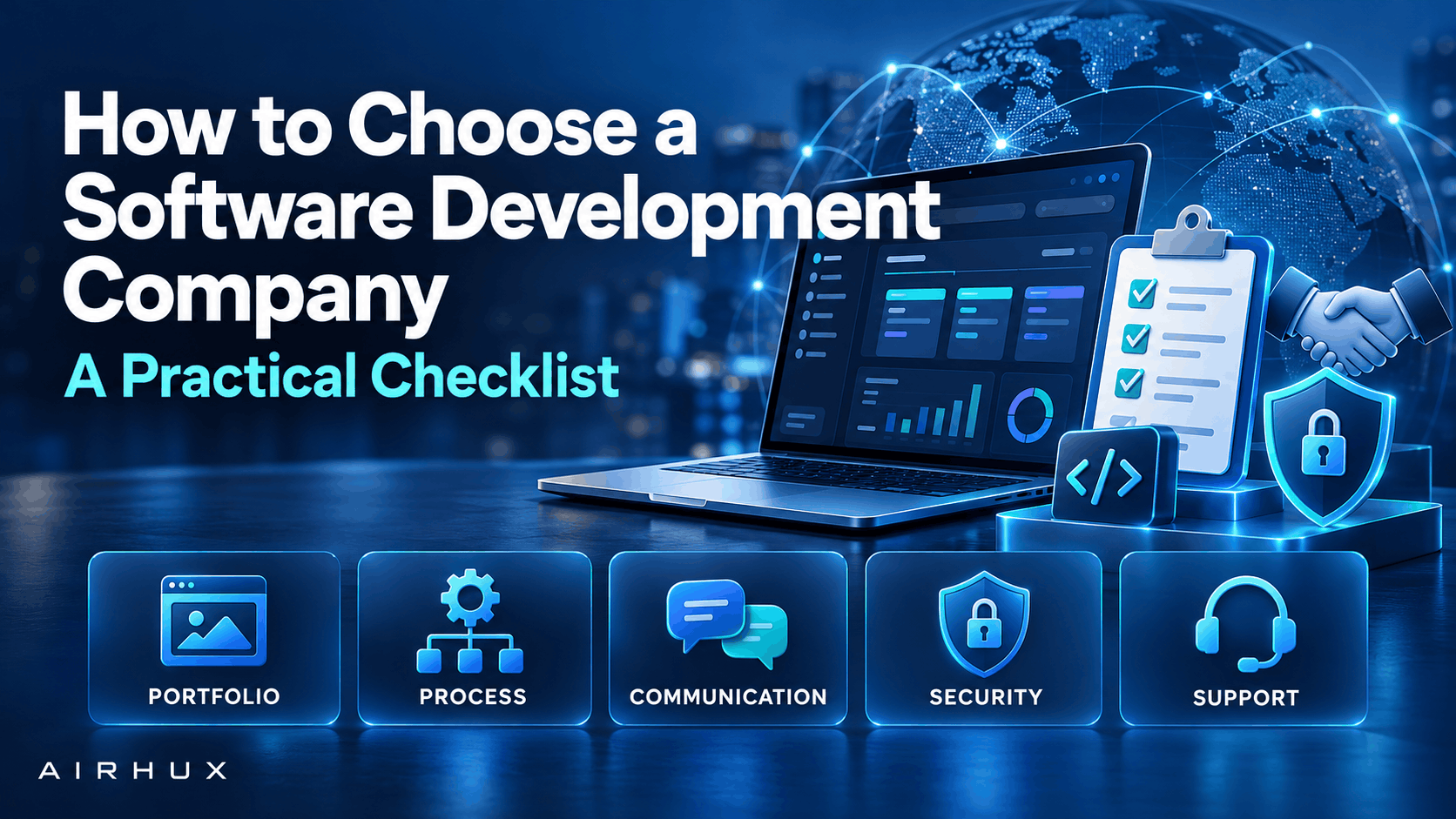
Knowing how to choose a software development company is mostly about reducing risk. You are trusting an outside team with a budget, a deadline and often a core part of your business. The right partner understands your goals, communicates clearly, works in a visible and testable way, and hands you code you fully own. The wrong one can cost months.
Price matters, but it is a poor first filter. A low quote built on vague assumptions often becomes the most expensive option once rework, delays and missing pieces are added. Start instead with evidence: what the company has built, how it works, and what its contract says.
This guide gives you a practical way to compare candidates and the red flags that should end a conversation.
1. Before You Choose a Software Development Company, Define Your Needs
You cannot judge a partner without knowing what you need. Before contacting anyone, write a short brief.
- The business problem and who the users are
- The core features for a first release
- Systems the software must integrate with
- Any compliance or security obligations
- Your budget approach and target timeline
- Who on your side will make decisions
A clear brief makes proposals comparable and shows you quickly which companies listened.
2. Review the Portfolio Critically
A portfolio shows what a company has actually delivered. Look past the visuals.
- Look for work similar in complexity to yours, not just in industry.
- Ask what the team specifically built: design, frontend, backend, integrations or all of it.
- Ask which projects are still live and still maintained.
- Try live products yourself where possible.
- Ask to speak with a past client, and prepare specific questions.
A company that has built and run its own products often understands maintenance and real-world operation better than one that only hands projects off.
3. Understand Their Development Process
Process is what turns an idea into working software on schedule. Ask the company to walk you through a typical project.
- How do they gather requirements and confirm scope?
- Do they run a discovery phase before committing to a full estimate?
- How often will you see working software, not just status reports?
- How are changes to scope handled and priced?
- Who is on the team, and will those people actually work on your project?
Look for short cycles with regular demos. Seeing progress often is the best early warning system you have.
4. Communication and Project Management
Many failed projects fail because of communication, not code.
- Confirm who your day-to-day contact is and how quickly they respond.
- Agree on meeting rhythm, reporting and tools for tracking tasks.
- Check time-zone overlap for live discussion.
- Notice how clearly they explain technical trade-offs during the sales process.
If questions go unanswered before you sign, expect the same afterward.
5. Code Ownership and IP in the Contract
This is the section people skip and later regret. Read the contract carefully, ideally with a lawyer.
- The contract should state that you own the source code and all intellectual property created for you once paid.
- You should have access to the code repository throughout the project, not only at the end.
- Clarify any third-party or pre-existing components the company reuses, and what license you get for them.
- Confirm who owns accounts for hosting, domains, app stores and third-party services. They should be in your name.
- Include confidentiality terms and, where relevant, a data processing agreement.
- Define what happens at termination: handover of code, documentation and credentials.
Owning your code is what keeps you free to change partners later. Our comparison of custom software vs off the shelf explains why this control matters.
6. Security Practices
Ask how the team protects your software and your data, not just whether it does.
- How are passwords, API keys and other secrets stored and shared?
- Who has access to production systems and data?
- How do they handle authentication, permissions and input validation?
- Do they review code for security issues and keep dependencies updated?
- How would they respond to a security incident?
A good partner answers these questions specifically and without hesitation.
7. Testing and Quality Assurance
Quality should be built into the process, not checked at the end.
- Do they write automated tests for important behavior?
- Is there dedicated QA, or do developers test their own work only?
- Which devices and browsers will be tested?
- Will you have a staging environment for acceptance testing before release?
Ask what their definition of "done" is for a feature. The answer reveals a lot about their standards.
8. Post-Launch Support and Maintenance
Launch is the beginning of the software's life, not the end of the project.
- What support is offered after launch, and on what terms?
- How are bugs prioritized and how fast are urgent issues handled?
- Who monitors the system, and who is alerted when something breaks?
- How are security updates and dependency upgrades handled?
- Will documentation be good enough for another team to take over?
Get support terms in writing before you sign the development contract.
9. Red Flags to Watch For
Some warning signs are worth taking seriously.
- A firm quote before they understand your requirements
- Promises that every feature can be delivered quickly and cheaply
- Reluctance to show past work or let you speak with clients
- No access to the code repository until final payment
- Contracts that leave IP ownership vague or keep it with the vendor
- Vague answers about who will actually do the work
- No mention of testing, security or maintenance
- Pressure to sign quickly
Common Mistakes to Avoid
- Choosing the lowest quote without comparing what each one includes
- Skipping a written brief and letting each vendor define the scope
- Signing a contract that does not transfer code ownership
- Letting the vendor own your hosting, domain or app store accounts
- Treating discovery as optional on a complex project
- Not planning for support and maintenance after launch
- Assigning nobody on your side to make decisions quickly
Frequently Asked Questions
Should I choose a local or remote software development company?
Either can work. What matters more is communication, process and enough time-zone overlap for regular discussion. A remote team with a clear process often outperforms a nearby team without one.
How many companies should I talk to?
Speaking with a few serious candidates is usually enough to compare approaches without drowning in proposals. Give each the same brief so their answers are comparable.
What questions should I ask a software development company?
Ask about similar past projects, their process, who will work on your project, how they handle scope changes, testing, security, code ownership and support after launch. Their answers, and how clearly they give them, are the best signal you will get.
Is a fixed-price contract safer?
Fixed price gives budget certainty when the scope is clear and stable. For evolving products, time and materials with regular demos is often more realistic. Read our guide on how much it costs to build an app for more on pricing models.
What should a handover include?
Full source code, documentation, deployment instructions, credentials for every account in your name, and an explanation of any third-party services. A good partner makes it possible for another team to continue the work.
How Airhux Can Help
Airhux Technology is a software company in New York that provides custom software development, web and mobile apps, AI and automation, cloud and UI/UX design. We also build and run our own products, including our Travel SaaS Platform, so we work on long-term operation and maintenance as well as launch.
If you are comparing partners, bring us your brief and the questions above. Start your project and we will walk you through how we would approach your project.
- how to choose a software development company
- software development partner
- hire a software development agency
- outsourcing software development
- questions to ask a software developer
- software development contract
- code ownership
- choosing an app development company