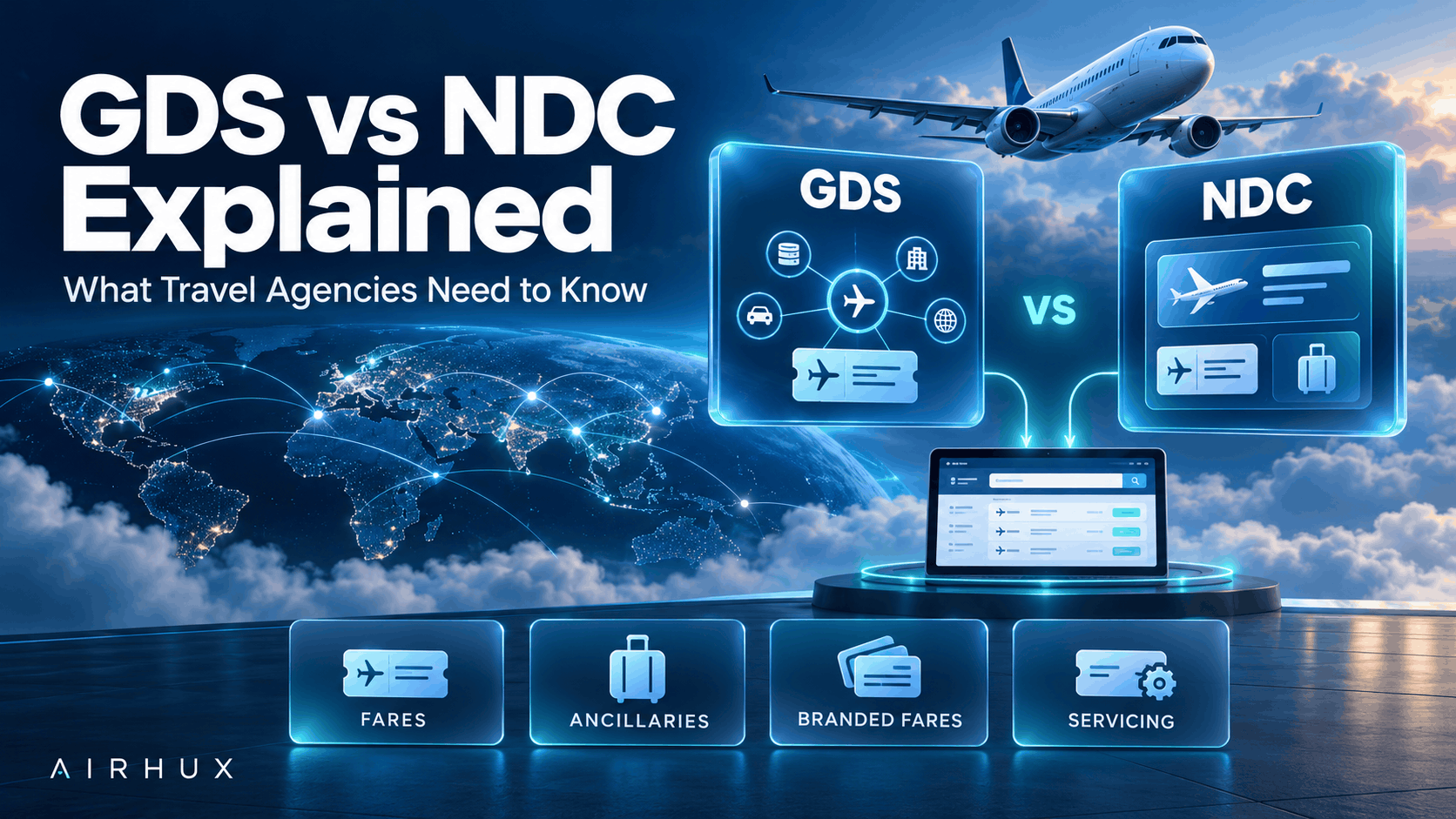
GDS vs NDC is a question about how airline content reaches a travel agency. A GDS (global distribution system) is a long-established network that aggregates fares and availability from many airlines in one standard format. NDC (New Distribution Capability) is an IATA standard that lets an airline send its own offers, prices and extras directly to agencies through a modern API.
Neither one fully replaces the other today. Most agencies that sell flights at scale use both, because some fares and extras appear only in one channel. This article explains how they differ in pricing, extras and servicing, and what that means for your business.
1. What a GDS Is
A GDS is a shared system that connects airlines with travel agencies. Airlines file their schedules and fares, and agencies search, book and issue tickets through it.
- One connection gives access to many airlines.
- Fares are built from filed fare rules, and bookings are stored as PNRs (passenger name records).
- Tickets are issued by the agency or its ticketing partner, usually under an accreditation such as ARC in the US or IATA elsewhere.
- Servicing tools for changes, refunds and voids have been refined over many years.
The strength of a GDS is breadth and consistency. The weakness is that the content can lag behind what an airline sells on its own website.
2. What NDC Is
NDC is a data standard published by IATA. Instead of filing fares into a shared system, the airline answers each shopping request with its own offer: a price, the fare brand, included bags and seats, and other extras it chooses to sell.
- The airline builds the offer in real time, so it can personalize and bundle.
- Content is closer to what the airline shows on its own site.
- Booking is an order held by the airline, and in many NDC flows the airline itself issues the ticket.
- Each airline implements NDC slightly differently, so coverage and features vary.
3. How Fares Differ
The same flight can show different prices in each channel.
- Some airlines publish fares or discounts only through NDC.
- Some airlines add a distribution surcharge to fares booked through traditional channels.
- GDS fares follow filed fare rules, which are detailed but structured.
- NDC offers can include dynamic prices that change from one search to the next.
For an agency, the practical effect is that showing both channels side by side can give customers more choice and, sometimes, lower prices.
4. Ancillaries and Branded Fares
Ancillaries are extras such as checked bags, seat selection and meals. Branded fares are named fare families, such as a basic, standard and flexible option, each with different inclusions.
- NDC: airlines usually expose their full range of brands and extras, with clear descriptions and images, because the standard was designed for that.
- GDS: branded fares and many extras are available, but support varies by airline and some extras may be limited.
Showing what each fare includes, such as bags, change rules and refundability, helps customers compare like for like and reduces support questions after booking.
5. Servicing: Changes, Refunds and Voids
This is where the two channels differ most for daily operations.
- Voids: on GDS tickets issued by the agency, a void is usually possible within a short window after issue, often the same day. On NDC, the airline controls the ticket and void options depend on the airline.
- Changes: GDS changes follow established exchange and reissue processes. NDC changes run through the airline's order change functions, which differ between airlines.
- Refunds: GDS refunds are typically processed by the agency and settled through its settlement plan. NDC refunds are usually requested from the airline, which processes them on its side.
- Schedule changes: both channels can notify agencies of airline schedule changes, but the mechanism differs, so you need a process that catches both.
Your staff and your technology need to know which channel a booking came from, because the right servicing action depends on it.
6. Ticketing Differences
On GDS content, the agency usually decides when to issue the ticket and which airline validates it. Not every agency is permitted to issue tickets on every airline, so a well-built system should only offer fares it can actually ticket.
On NDC, the airline typically issues the ticket as part of the order. This removes some ticketing restrictions but makes the agency more dependent on each airline's implementation.
7. Why Agencies Use Both
Using only one channel means missing content.
- GDS gives broad airline coverage and mature servicing.
- NDC gives fuller airline offers, extras and in some cases exclusive fares.
- Combining them lets you show the best available option for each search.
- Having both reduces risk if one channel has an outage or a carrier changes its distribution strategy.
The challenge is that combining channels means handling two different booking and servicing models. A good booking platform hides that complexity from customers while keeping it clear for staff.
Common Mistakes to Avoid
- Assuming NDC and GDS prices for the same flight will match.
- Treating every booking the same way when servicing, regardless of its source.
- Showing fares the agency cannot actually ticket.
- Hiding what each fare includes, which leads to disputes about bags and changes.
- Ignoring schedule-change notifications from either channel.
- Relying on a single content source for all airlines.
Frequently Asked Questions
Is NDC replacing the GDS?
Not fully, at least for now. Many airlines are expanding NDC, while GDS connections remain widely used for broad coverage and servicing. Most agencies plan for both channels.
Are NDC fares always cheaper?
No. Some airlines offer lower or exclusive fares through NDC, but prices vary by airline, route and date. Comparing both channels for each search gives the most accurate picture.
Who issues the ticket on an NDC booking?
In many NDC flows, the airline issues the ticket as part of the order. On GDS bookings, the agency or its ticketing partner usually issues it under its own accreditation.
Can I void an NDC ticket the same way as a GDS ticket?
Not always. Void rules on NDC depend on the airline's implementation. Check the airline's rules and your platform's servicing options before promising a void to a customer.
Do I need separate systems for GDS and NDC?
Not necessarily. A booking platform or flight booking API that combines both channels can present them in one search and one admin, while handling the servicing differences behind the scenes.
How Airhux Can Help
The Airhux Travel SaaS Platform gives travel agencies flight search and booking with worldwide airline content from both GDS and airline NDC sources, inside a white-label storefront on the agency's own domain, with a B2C site, a B2B agent workspace and an admin to service bookings. The same flight content is available to partners through the Airhux Flight Booking API.
To learn more about selling both channels under your own brand, become a travel partner. For custom development around your flight content, start your project.
- GDS vs NDC
- what is NDC in travel
- what is a GDS
- NDC airline content
- NDC vs GDS fares
- IATA NDC
- airline distribution
- NDC booking servicing